
How STEM Projects Help School Students Learn Through Real-World Experiments
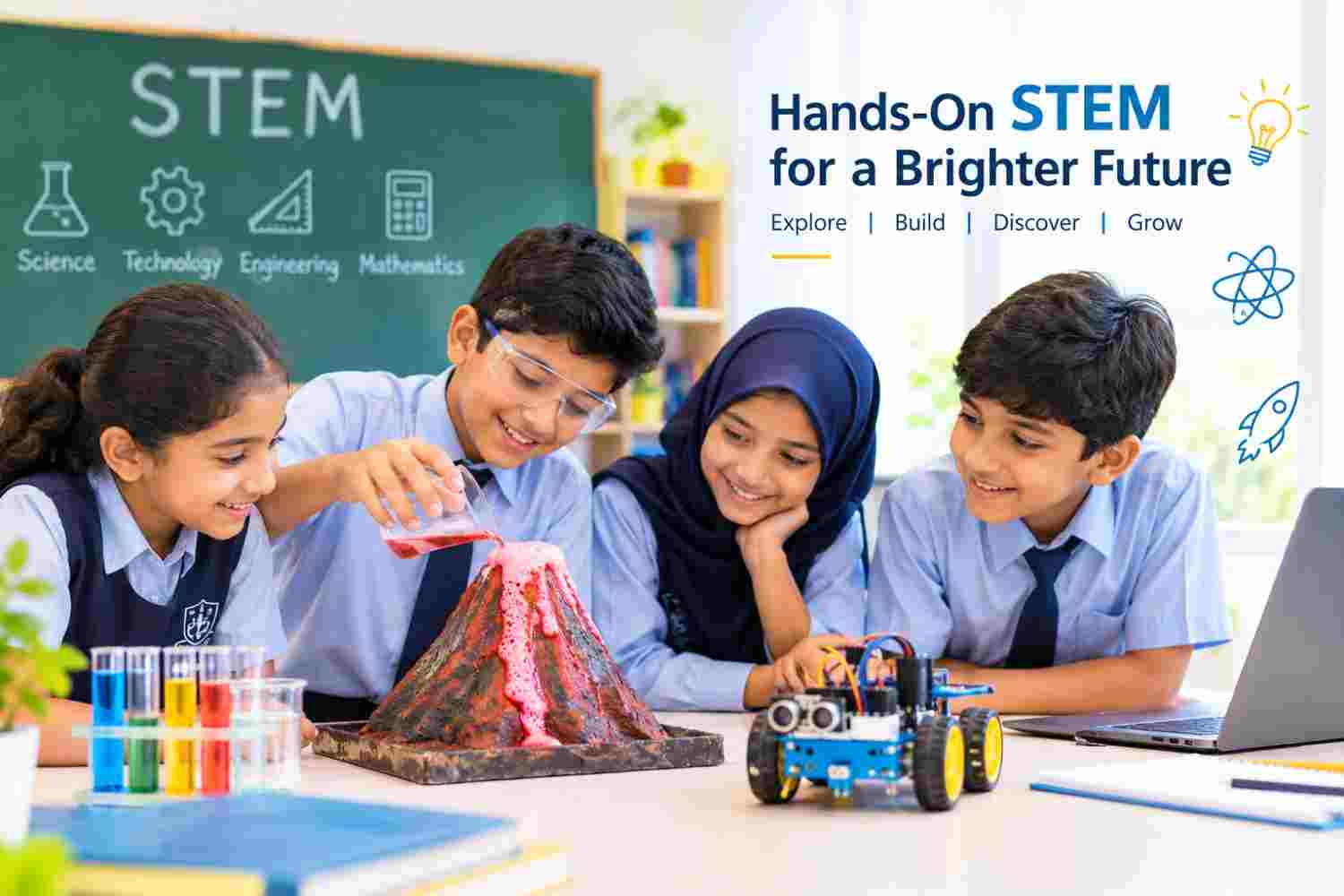
Remember the first time you saw a volcano erupt in a science fair? Baking soda, vinegar, a bit of red food colouring, and suddenly the whole class was leaning in. Nobody had to be told to pay attention. That moment of "wait, how did that happen?" is exactly what good STEM education is built on.
Today, STEM education in schools goes far beyond the occasional science fair. It's about letting students build, test, break and rebuild things until the ideas in their textbooks actually make sense. Let's look at why hands-on STEM projects work so well, and how parents and teachers can make the most of them.
So, What Exactly Is STEM Education?
STEM stands for Science, Technology, Engineering and Mathematics. But the real idea isn't just about four subjects sitting side by side on a timetable. It's about connecting them.
In the real world, problems don't arrive neatly labelled "physics" or "maths." An engineer designing a bridge uses maths to calculate loads, science to understand materials, and technology to model the design. STEM education teaches students to think the same way: pick up a problem, pull in whatever knowledge you need, and work it out.
Why Learning by Doing Just Works
Here's a simple truth: most of us forget what we hear, remember some of what we see, and really understand what we do. Hands-on learning activities tap into that.
When a student reads that plants need sunlight, it's a fact to memorise for the exam. When that same student grows two bean plants, one on the windowsill and one in a dark cupboard, and watches what happens over two weeks, it becomes something they know. They've seen the evidence with their own eyes.
Real-world experiments also make mistakes feel less scary. If a paper bridge collapses, that's not failure. That's data. Students learn to ask "why did that happen?" and "what can I change?" which, honestly, is the heart of all scientific thinking.
Science Projects That Spark Curiosity
Good science projects for school students don't need fancy labs. Some of the best ones use things you'd find in a kitchen. Testing which liquids conduct electricity, building a simple water filter with sand and charcoal, or measuring how fast ice melts in different conditions. These are small experiments, but they teach big ideas like variables, observation and fair testing.
Engineering projects take it a step further. Instead of just observing, students design and build. A rubber-band car, a paper tower that holds a book, a model of a rainwater harvesting system. Each one asks students to plan, test, fail, tweak and try again. That cycle of improving a design is exactly how real engineers work.
Robotics: Where It All Comes Together
If there's one area that gets students genuinely excited, it's robotics. And for good reason. Robotics education for students pulls every part of STEM into one project.
To build even a simple line-following robot, a student needs to understand circuits (science), write a bit of code (technology), put the parts together so they actually work (engineering), and figure out speeds, angles and distances (mathematics). It's all there.
What's great is that robotics kits have become far more accessible. Many schools now run robotics clubs and labs where students as young as eight start with block-based coding and gradually move on to sensors and microcontrollers. The joy of seeing something you built move on its own command? That's a lesson no textbook can match.
Easy STEM Activities You Can Try at Home
Learning doesn't stop when the school bell rings. Parents can keep the curiosity going with simple STEM activities at home, no special equipment needed:
- Egg drop challenge: Design a package that keeps a raw egg safe when dropped from a height. Great for engineering and problem-solving.
- Homemade lava lamp: Oil, water, food colouring and an antacid tablet show density and chemical reactions in action.
- Kitchen measurement games: Doubling or halving a recipe turns fractions into something tasty.
- DIY periscope: Two mirrors and a cardboard tube teach how light reflects.
- Free coding apps: Beginner-friendly platforms let kids create small games and animations while learning logic.
The trick is to ask questions rather than give answers. "What do you think will happen?" goes a long way.
The Skills That Go Way Beyond the Classroom
Sure, STEM projects help with grades. But the real payoff shows up years later. Students who grow up building and experimenting tend to develop:
- Critical thinking: They learn to question, test ideas and look for evidence.
- Resilience: When things don't work the first time, they try again instead of giving up.
- Teamwork: Most projects need students to share ideas, split tasks and listen to each other.
- Creativity: There's rarely one right answer, so they learn to think in new directions.
- Confidence: Building something that works gives a sense of achievement that sticks.
These are the skills every future career will need, whether your child becomes a scientist, a doctor, an entrepreneur or an artist.
Let Them Get Their Hands Dirty
At the end of the day, STEM education is about turning "I have to learn this" into "I want to figure this out." At Dauha Al Uloom International School, that's exactly the spirit we bring into our classrooms. We've adapted this hands-on approach for our kids, so science, engineering, robotics and maths aren't just chapters to finish. They're things our students build, test and explore for themselves.
We believe every child is a natural explorer. Our job is to give them the space, the tools and the encouragement to ask "why?" and go find the answer. If you're looking for a school where curiosity is celebrated and learning feels real, we'd love for you to visit Dauha Al Uloom International School and see our young innovators in action.